Where Is Your Main Water Shut Off Valve Located?
Find your main valve today, while nothing is leaking, so you can stop the water in seconds when a pipe lets go.
See where to look firstStart with the pipe beside your front hose bib
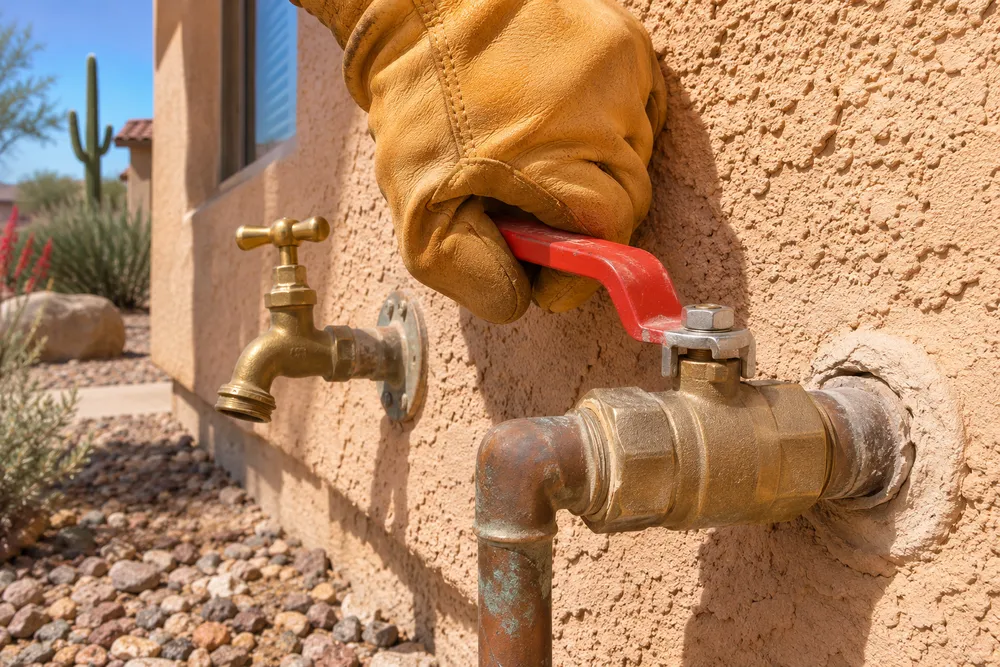
On many desert homes the main water shut off valve is a short walk from the front door. Follow the hose bib back toward the ground and look for a second pipe with a lever or a round handle on it, often with a short length of insulation or a cover box.
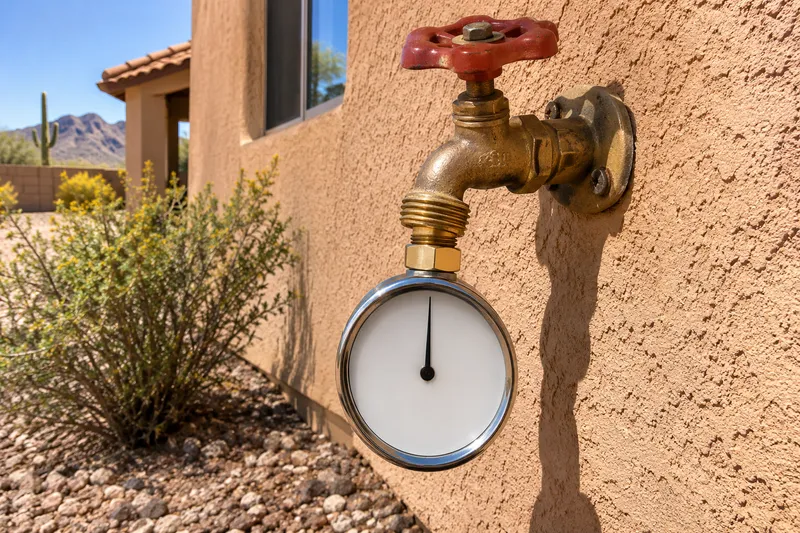
Gravel and shrubs tend to hide it, so clear the area around the pipe and keep it clear. While you are there, a plumber can thread a gauge onto the hose bib to check the pressure in your lines.
If you find nothing on the outside walls, move to the garage, then to the meter box.
Ball valve or gate valve, and how each one closes
Once you find the valve, look at the handle. It tells you what kind of valve it is and how to close it.
Ball valve with a lever
- A straight lever handle, often red or yellow.
- The lever lies parallel to the pipe when the valve is open.
- Closed after a quarter turn, when the lever sits across the pipe.
- Quick and reliable, which makes it the better choice for an emergency.
Gate valve with a round wheel
- A round handle that looks like a small wheel.
- Turn it clockwise several full turns to close it.
- Older gate valves can stick or stop sealing fully.
- Never force a stiff wheel, because the stem can snap inside the valve.
How to close the main water shut off valve fast
Practice this once when nothing is wrong. In a real leak you will be glad your hands already know the way.
Go straight to the valve
Leave towels and buckets for later. Every second the water runs adds to the damage inside the house.
Turn it the right way
Give a ball valve a quarter turn so the lever crosses the pipe. Turn a gate valve clockwise until it stops.
Check that it worked
Open a faucet inside the house. After a short burst, the flow should slow to nothing within a minute or two.
Shut off the water heater
If the leak is near the heater, also close the cold supply valve on the pipe above it and turn off its gas or power.
With the water off, follow our plumbing emergency steps to protect the house while you wait for a plumber.
Smaller valves that stop water at one fixture
Shutting off the whole house is not always necessary. Toilets, sinks and the water heater each have a small stop valve that isolates that one fixture.
| Fixture | Where the valve is | How to close it |
|---|---|---|
| Toilet | Behind the toilet, low on the wall or floor under the tank | Turn the oval handle clockwise until it stops |
| Kitchen or bath sink | Inside the cabinet, one on the hot line and one on the cold | Turn each handle clockwise |
| Water heater | On the cold pipe above the tank | Quarter turn on a lever, or clockwise on a wheel |
| Washing machine | Behind the washer, at the two hose connections | Turn both handles clockwise |
| Ice maker or dishwasher | Under the kitchen sink, on a small branch line | Turn the small handle clockwise |
If a fixture stop spins without closing or drips once you turn it, it is worn. A plumber can replace it during faucet and sink repair or toilet repair.
Test the main water shut off valve twice a year
Valves that sit untouched for years can seize, especially in hard water. Pick two easy dates, such as the first warm week of spring and the start of fall, and close the main valve fully, then open it again.
If the handle is stiff, turns without stopping the water or leaks at the stem when you move it, have it replaced before you need it in a hurry. Swapping a worn valve is a routine part of pipe repair. A quick test now beats a stuck valve during a burst pipe.
Times you will be glad you know where the valve is
The main valve is not only for disasters. These everyday situations all go more smoothly when you can close it without searching.
A pipe bursts or a fitting lets go
Water from a burst supply line comes out at full pressure and does not slow down on its own. Closing the main valve is the only thing that stops it, and the first minute matters most.
Once the flow stops, a plumber can cut out the damaged section. Our pipe repair page explains what that visit involves.
The water heater starts leaking
Close the cold supply above the heater first. If that valve is stuck or the leak is on the supply side, close the main valve instead, then turn off the gas or power to the heater.
When the tank body itself is leaking, it needs water heater repair or a replacement, so leave the water off until a plumber has looked at it.
You suspect a hidden leak
Closing the house valve and watching the meter tells you whether a leak is inside the house or out in the yard line. If the meter stops with the house valve closed, the leak is indoors.
If it keeps moving, the underground pipe from the meter to your home is the likely culprit. Either way, leak detection can pinpoint the spot.
A plumber needs to work on the pipes
Many repairs need the water off at the main. Knowing where it is and that it closes properly lets the job start right away and keeps the visit shorter.
What to do if the main valve is stuck
A valve that will not move is common on older homes. Forcing it with a long wrench can break the stem or crack the pipe, which turns a small leak into a big one.
When the house valve fails, the valve in the meter box is your backup. Inside the meter box, the valve before the meter belongs to the water utility and often needs a meter key, so use it only in a true emergency or phone the utility for help.
While you wait for help
- Close the fixture stop nearest the leak if there is one.
- Turn off the water heater if the leak is anywhere near it.
- Switch off electricity to any room where water is reaching outlets or appliances.
- Move valuables and soak up standing water with towels.
- Call us and say that the main valve is stuck, so the plumber comes ready to replace it.
Turning the water back on without a new leak
Opening the main valve too fast can jolt the pipes. Bring the water back slowly.
Open it in stages
Turn a ball valve slowly toward open, or open a gate valve one turn at a time. Leave one faucet open inside so trapped air can escape as the lines fill. Expect sputtering for a minute.
Walk the house afterward
Look under sinks, behind toilets and around the water heater for drips. Listen for hissing in walls. A meter that keeps spinning with every tap closed means water is still escaping somewhere, which our guide on why your water bill is so high helps you track down.
Restart the water heater last
If you shut off a heater, make sure it is full before restoring gas or power. Open a hot tap and wait until the water runs steadily, then turn the heater back on. If the tank is due for a clean anyway, our guide to flushing a water heater shows how to do it while the water is already off.
Questions about the main water shut off valve
What if I cannot find a main valve on the house at all?
Some homes, especially older ones, only have the valve in the meter box. If you have searched the front wall, the garage and the yard, ask a plumber to locate it on the next visit. Adding a house valve near the entry point is a simple job that makes emergencies much easier.
Does closing the main valve turn off the irrigation too?
It depends on where the irrigation line branches off. If it tees off before the house valve, the sprinklers or drip system will still have water. In that case the meter box valve is the only way to stop everything at once.
Is it safe to leave the main valve off while I am away?
Yes, closing it before a long trip is a smart habit, because a failed hose or fitting cannot flood the house while you are gone. Turn off the water heater as well, or set it to vacation, and leave the irrigation on its own supply if it has one.
My main valve leaks at the handle. Is that serious?
A small drip at the stem usually means the packing inside the valve has worn. It is not an emergency, but the valve may not close fully when you need it.
Have it checked during your next repair. A slow, steady leak near the valve can also point to a water line repair if the drip is coming from the pipe rather than the handle.
Should I label the valve?
Yes. Hang a tag on the handle and show everyone who lives with you where the valve sits and which way it turns. Keep a pair of work gloves close at hand and, if the valve is in the meter box, keep a meter key where you can find it quickly.
Guides to read once the water is off
A closed main valve is the first step. These guides help with what comes after, from protecting the floors to finding where the water went.